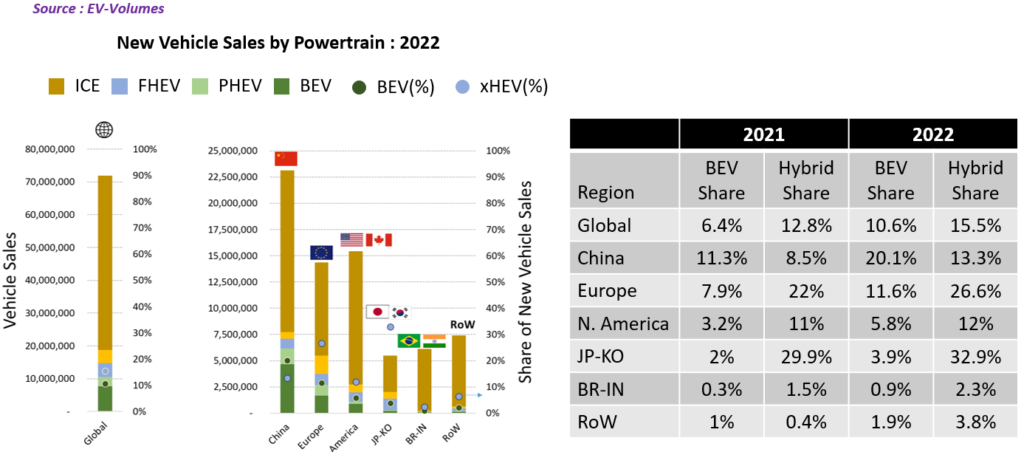
2022 Light-duty vehicle sales by powertrain and regional split

A summary of 2022 light-duty vehicle sales globally and by region, and split by powertrains.

A summary of 2022 light-duty vehicle sales globally and by region, and split by powertrains.

In case you are confused by the Inflation Reduction Act in the US and it’s implications for electric vehicle incentives, then you are not alone. It’s an evolving story, and the U.S. Treasury Department is making clarifications to help consumers understand what’s in it for them. The latest revised guidelines expand the list of vehicles which qualify for the $7,500 tax credits. Here’s a summary.
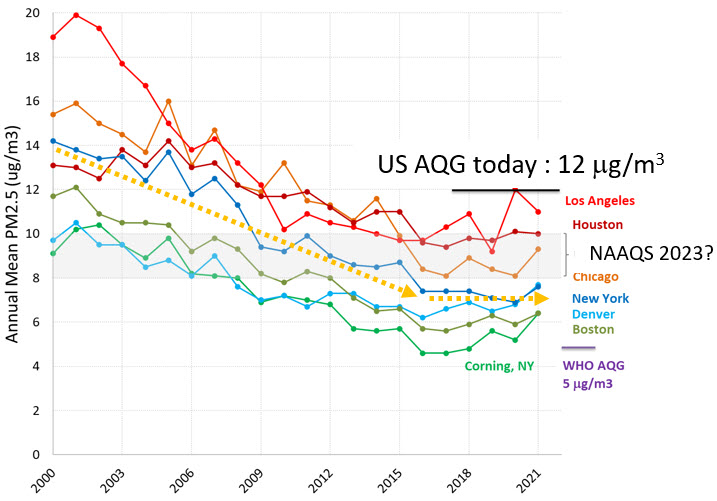
The US EPA has proposed to revise the annual PM2.5 national ambient air quality standard (NAAQS) from 12 ug/m3 (micrograms per cubic meter) to a level of 9 – 10 ug/m3. See here for a overview on reasons and implications.
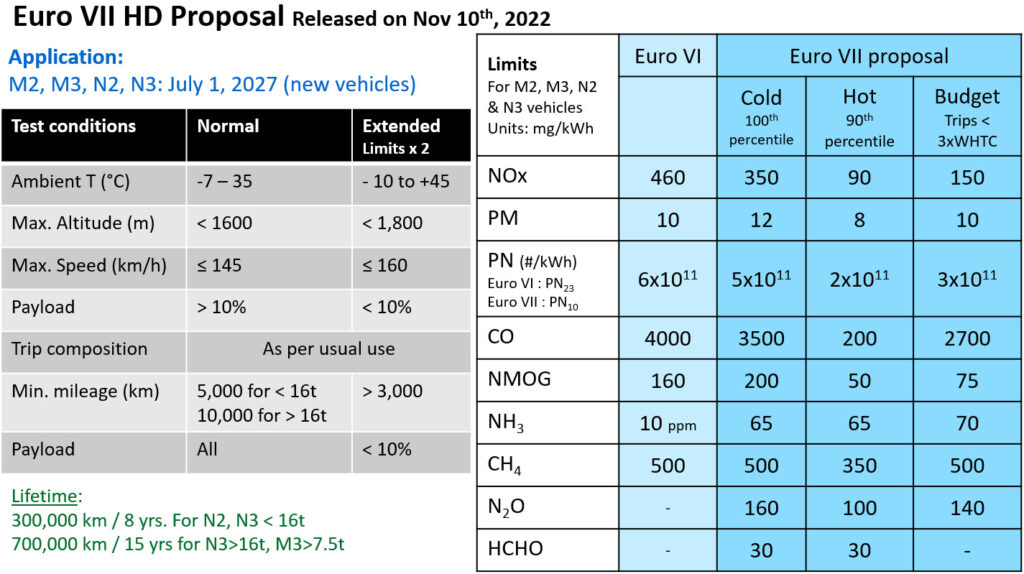
The EU Commission has proposed Euro 7 / VII emission standards for light- and heavy-duty vehicles. Here is a quick tabular summary.
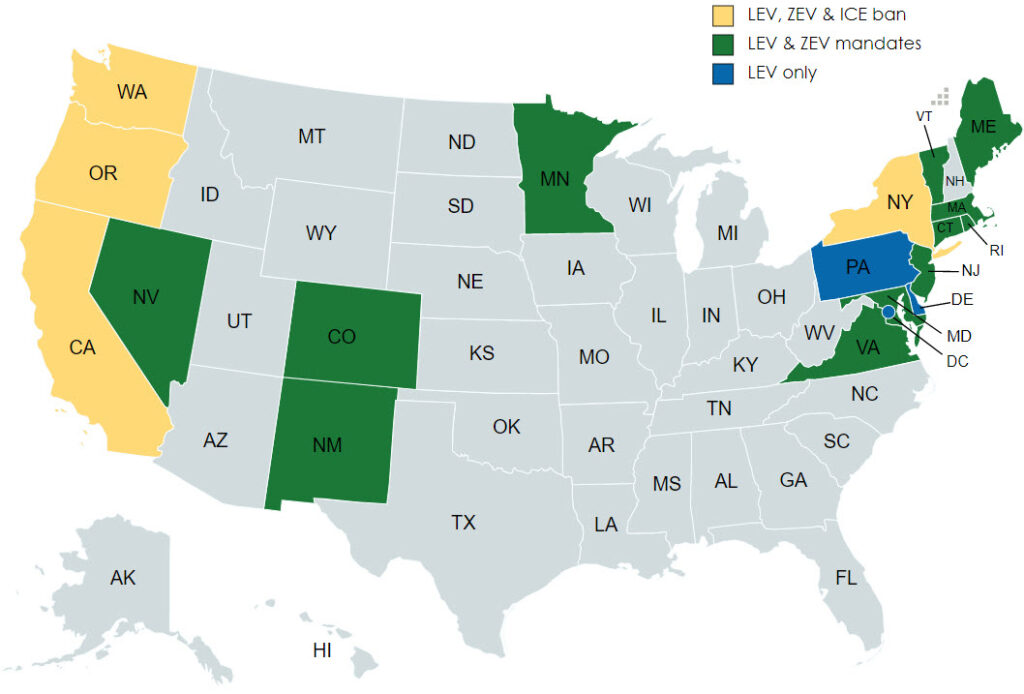
Around 40% of the US now follows California’s tougher-than-federal criteria pollutant standards. Here’s a summary of the latest, including followers of the Advanced Clean Cars rule.

Here’s a summary of possible changes to emission standards for passenger cars being considered as part of Euro 7.

The US EPA has revised the fuel economy standards for model years 2023 – 2026. On average, this will require fleet averaged annual reductions of CO2 or fuel consumption by 7%. Overall, the model year 2026 CO2 emissions will be further reduced by 23% compared to the previous Safer Affordable Fuel-Efficient (SAFE) rule.
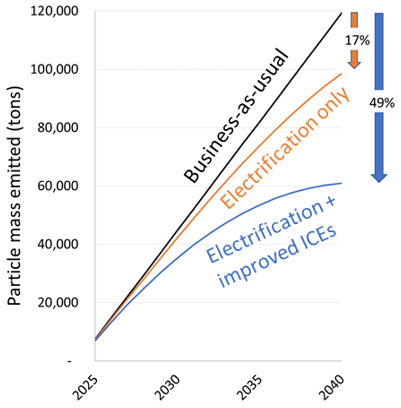
A simple calculation, taking the US as an example, to show that improving air quality for the next couple of decades will require that we continue to improve IC engines, even as electrification proceeds rapidly.

If you have not heard of the term “Environmental Justice” or “EJ” as it is abbreviated, then it’s time to read up. Policy makers have to pay close attention to this topic in the quest for a rapid transition to greener energy and mobility.
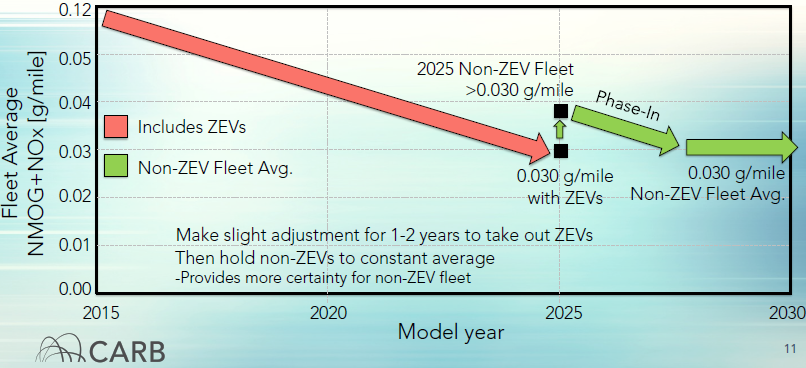
California Clean Cars 2.0 : Emission standards beyond 2025 Based on workshops held by California’s Air Resource Board (CARB) Background California has the world’s toughest gas emissions standards for light-duty vehicles. The standards phase-in to 30 mg/mi of combined non-methane organic gases (NMOG) and nitrogen oxides (NOx) by 2025. CARB is now considering tightening these and other standards even more beyond 2025, while also promoting reduced fuel consumption and electrification of the fleet. A few key takeaways follow. Non-ZEV SULEV 30 fleet and pathway to 100% EV sales by 2035 California’s Air Resource Board (CARB) is aiming for further NOx and particulate reductions from the light-duty fleet. Here’s a summary of the proposed approach, based on a workshop held on May 6th, 2021. Fleet Electrification CARB Electric Vehicle Sales Targets Goal is to achieve 100% plug-in electric sales by 2035. Move from credit driven to sales driven approach: one ZEV credit per ZEV, with 5-year credit life. PHEVs must have > 50mi all-electric range, must be able to complete US06 on all electric mode, and meet SULEV30 & zero evaporative emission standards. 20% cap on PHEVs allowed to fulfill OEM obligation to ZEV requirements. As input to cost modeling, it