Euro 7 Implications for gasoline particulate filters

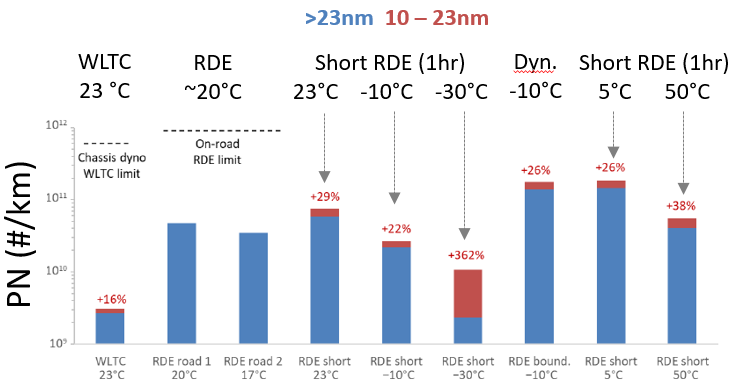
GPFs work well under wide operating conditions. But, very higher filtration will be needed for Euro 7. Journal Paper Review : Particle Number Emissions of a Euro 6d-Temp Gasoline Vehicle under Extreme Temperatures and Driving Conditions https://www.mdpi.com/2073-4344/11/5/607 Background Tailpipe particle number (PN) measurements were done on a Euro 6d-temp vehicle with a close-coupled TWC and uncoated GPF in the underfloor position. Ambient temperature and driving conditions were varied. Key Takeaway (1) The tailpipe PN emissions were well below the Euro 6d limit over a wide range of ambient temperatures (-30 to + 50 C), when driving aggressively (dynamic RDE) and under stop & go conditions (“Transport for London, TfL” test), and even when including particles down to 10 nm. Key Takeaway (2) Tailpipe PN emissions were low even at very low ambient temperatures. Surprisingly the emissions peaked at 5 deg C and not at the lowest temperature (PN is expected to increase with low ambient temp. due to fuel impingement on colder surfaces and incomplete combustion). However, the authors point out that a dynamic RDE test was done before the testing at 5 C, so that the filter was most likely passively regenerated and was in a “clean” state (i.e. without