Regulations / Electrification
Delhi Proposes Mandatory EV-Only Registrations for Two- and Three-Wheelers
Reference: Delhi Transport Department
Background
India’s Delhi Government has released a draft Electric Vehicle Policy 2026–2030 on April 11, 2026, open for public comment until May 10, 2026. The draft is significant because it proposes outright bans on new registrations of internal combustion engine (ICE) two-wheelers and three-wheelers within the next two years – among the most aggressive electrification mandates announced by any major city globally.
Delhi’s air quality crisis is well documented. A recent report by the Commission for Air Quality Management (CAQM), submitted to the Supreme Court of India, identified vehicular emissions as the single largest contributor to air pollution in Delhi, accounting for approximately 23% of winter pollution. Two-wheelers alone constitute roughly 67% of the city’s total registered vehicle stock, making their electrification a high-priority target.
Delhi’s earlier EV policy, launched in 2020, set a target of 25% EV share in new registrations by 2024. That target was not fully met – the city reached approximately 14% EV share by 2025, compared to a national average of about 8%. The new draft policy shifts from voluntary incentive-driven adoption to regulatory mandates. For related developments in India’s EV ecosystem, see the previously published MobilityNotes article on India’s Battery Pack Aadhaar Guideline.
Key Mandates and Incentives
The draft policy proposes a phased approach to mandatory electrification. From January 1, 2027, only electric three-wheelers (L5 category) will be permitted for new registration in Delhi. From April 1, 2028, the same restriction extends to two-wheelers – effectively banning the sale and registration of new petrol-powered scooters and motorcycles in the capital. Fleet aggregators and delivery service providers are already barred from adding new ICE four-wheeler LCVs and two-wheelers to their fleets as of January 1, 2026.
These mandates are paired with purchase incentives on a declining schedule: electric two-wheelers (priced up to ₹2.25 lakh) receive ₹10,000/kWh in Year 1 (max ₹30,000), tapering to ₹3,300/kWh (max ₹10,000) by Year 3. Three-wheeler incentives start at ₹50,000 and decline to ₹30,000 over three years. Scrapping incentives, road tax and registration fee exemptions, and school bus electrification mandates (30% of fleets by March 2030) round out the package. The total policy outlay is reported at approximately ₹3,954 crore (~$470 million).
Scale of the Challenge
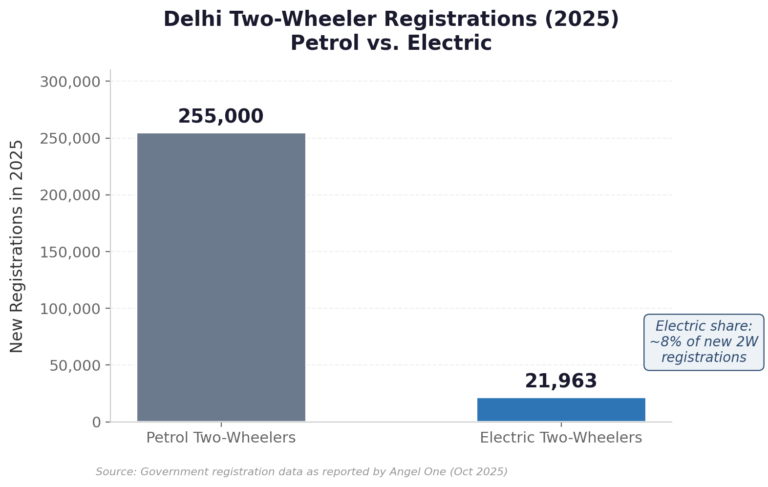
While the policy’s ambition is noteworthy, the gap between current EV adoption and a 100% mandate is significant. In 2025, Delhi registered over 255,000 petrol two-wheelers compared to approximately 22,000 electric two-wheelers – a ratio of roughly 8 electric for every 100 conventional. Charging infrastructure has expanded from a few hundred points in 2020 to approximately 9,000 by early 2026, but stakeholders have flagged gaps in residential areas, grid readiness, and EV financing (interest rates of 15–20% for commercial EVs) as persistent barriers.
MOBILITYNOTES MEMBERS: Click below to download the premium article, which includes a detailed breakdown of the incentive structure by vehicle segment, a comparison table of Delhi’s mandates against other Indian state EV policies, analysis of charging infrastructure readiness, implementation challenges including EV financing barriers and grid capacity concerns, and a discussion of what these mandates could mean for OEMs and fleet operators.
Sign up here to receive such summaries and a monthly newsletter highlighting the latest developments in transport decarbonization
5-Min Monthly
Sign-up to receive newsletter via email
Thank you!
You have successfully joined our subscriber list.
Recent Posts

Delhi Proposes Mandatory EV-Only Registrations for Two- and Three-Wheelers
![]()
A summary of Delhi’s draft EV Policy, which is amongst the most aggressive electrification mandates announced by any major city globally.

Lifecycle Analysis of U.S. Medium- and Heavy-Duty Vehicle Fuel Pathways
![]()
A recent study published in Environmental Science & Technology evaluates the lifecycle energy use and greenhouse gas (GHG) emissions of medium- and heavy-duty vehicles (MHDVs) in the United States.

EPA Demands Manufacturer Data as It Expands Action on DEF System Failures
![]()
A brief summary of recent EPA changes to DEF-related failures.