Technology Update
Stellantis Hurricane 4 Turbo packs more with advanced combustion technologies
See official Stellantis video for more details.
Reference for Mercedes-Benz engine: “Modular Gasoline Engine MGE: Combined Competence for Worldwide Success – A Cooperation Engine by Mercedes-Benz and Aurobay”, 46th International Vienna Motor Symposium, May 2025.
In case you thought OEMs have stopped investing in internal combustion engines:
Stellantis just announced that their latest engine – the four cylinder 2.0 liter “Hurricane 4 Turbo” – delivers 20% more power at 324 hp (240 kW) and 332 lb.-ft (450 Nm) torque, while reducing fuel consumption by 10% compared to the current 2.0 liter version.
The engine will make its debut with the 2026 Jeep® Grand Cherokee.
A brief summary of the advanced technologies adopted.
Advanced combustion
Miller Cycle with Early Intake Valve Closure (EIVC)
Compression Ratio of 12:1
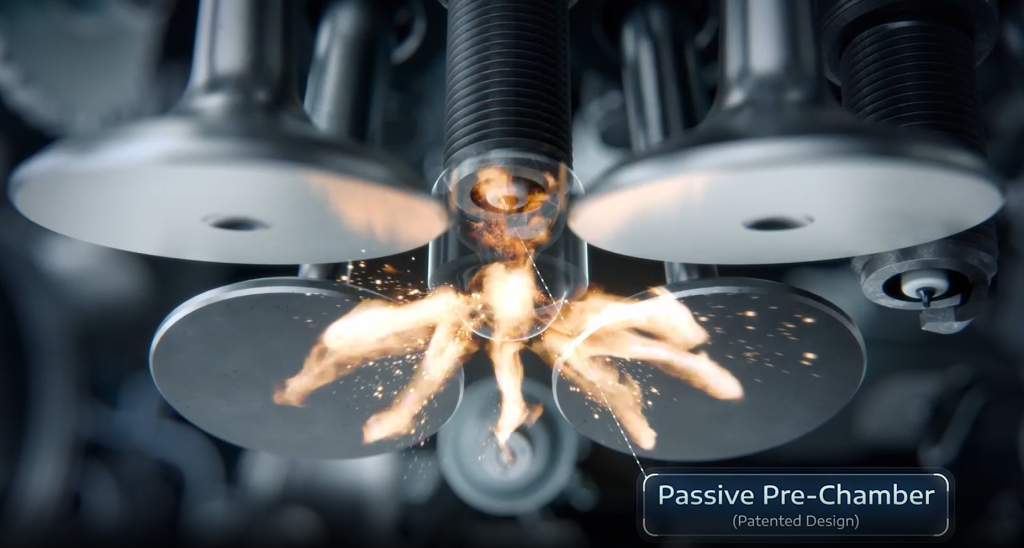
Passive Pre-chamber
Use of Turbulent Jet Ignition (TJI)
Two spark plugs per cylinder
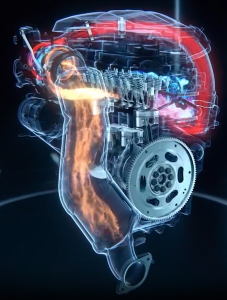
Turbocharging
Variable geometry turbocharger (VGT) with wastegate for early catalytic converter heating.
Pre-chamber technology is not new, it has been developed for a few years now. Here’s a review published as far back as 2010. And see here for a video by MAHLE, which has made significant advances in the technology in the past years. But as with any technology, it takes years for commercialization, and it’s good to see this being increasingly adopted.
Other technologies include the use of both port- and direct fuel injection, the latter at 350 bar. The contribution of each injection system depends on the engine operating map (e.g. both for cold starts, mostly GDI for higher power). And the use of electric water pump and variable displacement oil pump for lowering parasitic losses.
Earlier this summer, Mercedes-Benz and Aurobay presented a paper at the Vienna MotorSymposium (reference above near title). The talk discussed advances made to their 1.5L engine which also delivered 10% lower fuel consumption compared to the reference 2L engine (so included downsizing) and also operating at 12:1 compression ratio and Miller cycle.
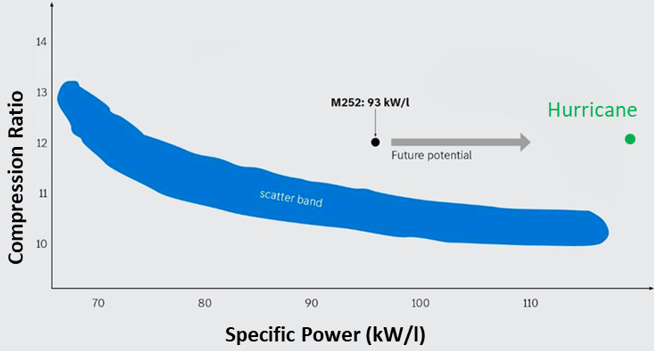
One chart presented was the scatter band of compression ratio vs. specific power. The Hurricane engine is clearly meeting the “future potential” shown in the chart.
(Note: this is not meant to be a comparison of the engines, the Mercedes-Benz engine was impressively optimized for Euro 7 / SULEV 20 and also paired with P2 hybrid architecture).
Sign up here to receive such summaries and a monthly newsletter highlighting the latest developments in transport decarbonization
5-Min Monthly
Sign-up to receive newsletter via email
Thank you!
You have successfully joined our subscriber list.
Recent Posts

ACT Expo 2026 – Propane Technologies Gain Momentum
![]()
Propane for buses, medium-duty and Class 7 trucks – and electrification? A range of exciting advances shown at the 2026 ACT Expo.

Delhi Proposes Mandatory EV-Only Registrations for Two- and Three-Wheelers
![]()
A summary of Delhi’s draft EV Policy, which is amongst the most aggressive electrification mandates announced by any major city globally.

Lifecycle Analysis of U.S. Medium- and Heavy-Duty Vehicle Fuel Pathways
![]()
A recent study published in Environmental Science & Technology evaluates the lifecycle energy use and greenhouse gas (GHG) emissions of medium- and heavy-duty vehicles (MHDVs) in the United States.