Webinar Summary

Advanced Propane Engine Technology - A Sustainable Power & Mobility Solution

Webinar hosted by the Engine Technology Forum. Click here for full recording.

Advanced propane engines are enabling cleaner, cost-effective, and sustainable mobility across transportation sectors. This webinar, hosted by the Engine Technology Forum, brought together panelists who showed real-world examples highlighting the use of propane as a viable, cost-effective and scalable alternative to diesel and gasoline.

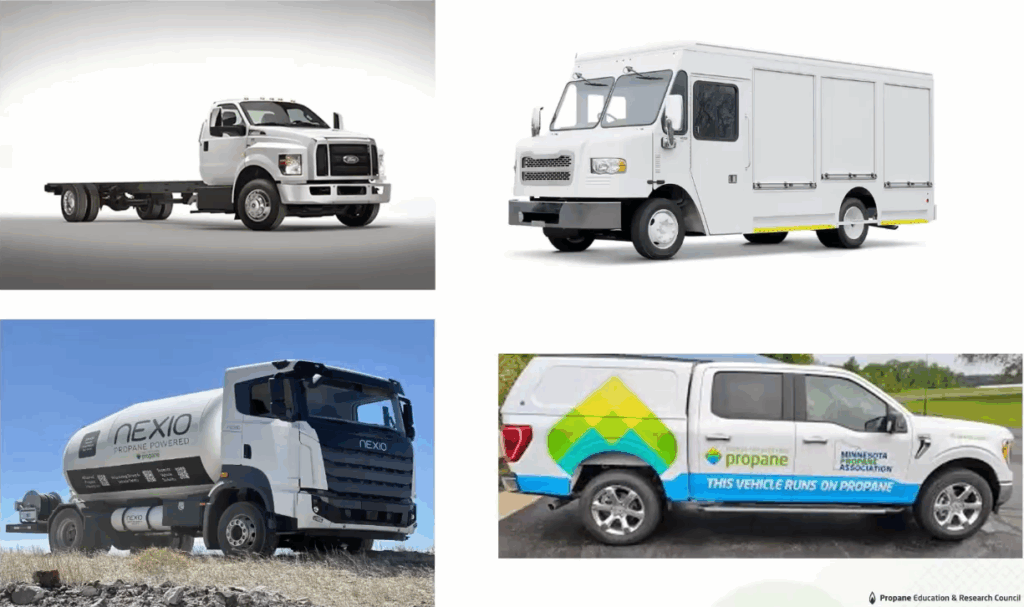
Tucker Perkins, President & CEO, Propane Education and Research Council (PERC), gave an overview of the engine technology. Propane engines are evolving toward diesel-level thermal efficiency (~44% BTE), and engines are being developed to meet various end applications. Some examples of propane-powered engines include:

    • Ford 7.3L engine, the primary workhorse
    • GM 6.6L engine, a new introduction and one of the first direct-injected solutions
    • Cummins 6.7L, not commercialized for now, but technology proven
    • Nexio 7.2L Supercharged engine powered by propane only – in development, commercial production by end of Q3 2026

There are ~ 75,000 vehicles run on propane in the U.S. – mostly in aftermarket, fueled by gasoline & propane. Currently these are mostly in the Class 4 – 7 applications. Class 8 trucks have not been the target yet, but may present the next opportunity with the growing importance of hybrid powertrains.

Propane offers key advantages of lower fuel & maintenance cost, ultra-low emissions, inexpensive and widely available infrastructure, and lower carbon intensity. These were discussed in greater detail by the following speakers. 

Roush has deployed 50,000 propane vehicles (school buses, trucks, fleets) across 3,500 fleets, covering over 3 billion miles.

Todd Mouw – EVP, Roush CleanTech discussed their experience: 

  • Propane excels in Class 4–7 vehicles: school buses, paratransit, and medium-duty trucks. There are > 22,000 propane Blue Bird school buses deployed across the US.
  • Propane is a resilient fuel: 30 billion gallons of propane are produced in the US each year, of which 20 billion gallons are exported !
  • There are > 3,000 refueling stations across the U.S.
  • Training & Support: Extensive technician and driver education available, onsite and online, ensuring safe, seamless fleet adoption
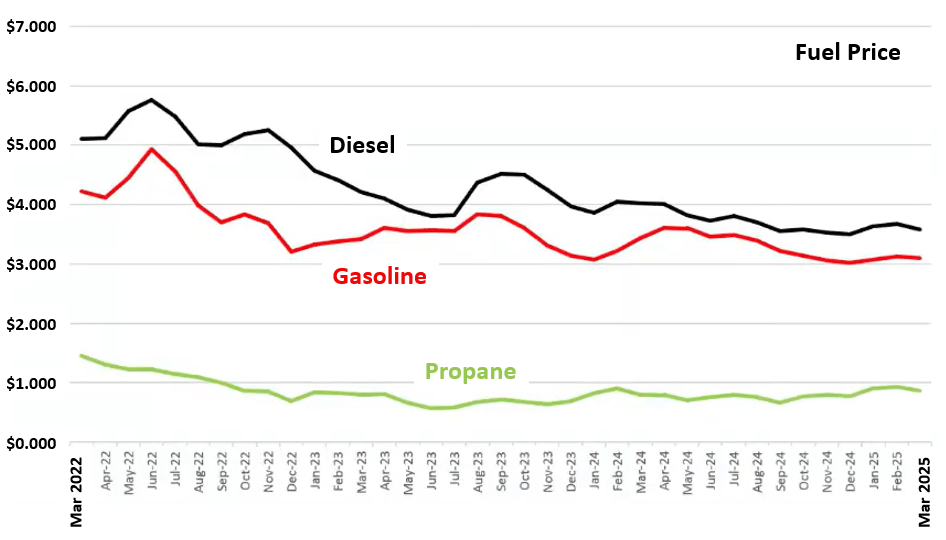
  • The price of propane has been significantly and consistently lower than diesel and gasoline, providing certainty to fleet operators on the cost savings for years to come. Note that the energy content of propane is 30% lower than diesel, but that is more than compensated for by the ~ 70% lower energy cost (vs.diesel).
  • Case studies shown where fleets found a 0.16 – 0.34 ¢/mile savings in fuels alone. This translates to ~ 30 – 50% lower cost per mile compared to diesel.
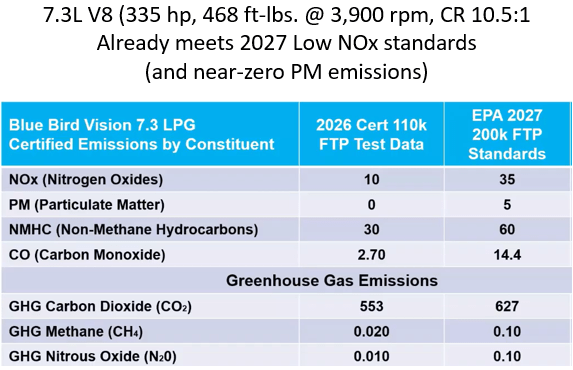
  • Emissions of the Roush 7.3L Propane engine are already meeting upcoming 2027 Low NOx and GHG standards (while emitting near-zero PM emissions)
  • Propane has 105 octane, which enables operation at 10.5:1 compression ratio for the 7.3L V8 engine.

Propane was one of the single-best decisions we as an organization have made” – savings, no loss of performance, and drivers love the vehicles !

Tim Geibel – Executive Director, Crawford Area Transportation Authority brought home the advantages of propane with a real-world example:

  • In 2025, 40% of paratransit buses are operating on propane. They started with converting 5 vehicles to run on propane in 2021, and based on early success, added 9 more in 2023 (and a 2nd fueling location), and again added 11 vehicles in 2025.
  • Savings: 94,000 gallons of propane used in 2024, saving $164,500 vs. gasoline. Translates to ~33% lower cost per mile vs gasoline, and 67% vs natural gas. Fueling at site costs ~ $1.06 (compared to > $3 for gasoline) and that includes all site maintenance.

Key Takeaways

  • Propane can be a “destination fuel”, that is one that provides sustainable transportation on its own merit and not simply as a bridge to alternate fuels.
  • Fleets report strong economic, operational, and environmental outcomes, positioning propane as a core technology in the clean-energy transition.
  • It provides a clean, affordable, and scalable path to decarbonizing transportation.
  • Renewable propane strengthens the sustainability case, offering near-carbon-neutral performance.
  • While traditional applications include Class 4 – 7 vehicles, expect more to come in other applications, given the continued development of engine technology, hybridization and emission reductions.

Sign up here to receive such summaries and a monthly newsletter highlighting the latest developments in transport decarbonization

Recent Posts