Journal Paper Summary
NOx emissions inventories - Role of improved HD ICE technologies
Guest contribution by Troy Hurren, PhD Candidate | CE-CERT
Link to Original Publication
Heavy-duty vehicles (HDVs) are a major source of nitrogen oxides (NOₓ), harmful pollutants that contribute to smog formation and respiratory illnesses—especially in communities near ports, freeways, and warehouses. It is expected that improvements in diesel engines, including ongoing advances in emissions control technologies and engine efficiency, and cleaner fuels, coupled with engines manufactured after 2027 being required to meet a much stricter EPA NOx standard of 0.035 g/bhp-h—nearly ten times lower than the limit set in 2010, will lead to a reduction in the overall emissions inventory for HDVs, but this topic has not been extensively evaluated.
In a recent study published in Science of The Total Environment, the University of California at Riverside’s (UCRs) Bourns College of Engineering – Center for Environmental Research and Technology evaluated how modern diesel and natural gas engines are already performing in the real world and what their adoption could mean for future emissions inventories.
UCR analyzed emissions data from 63 HDVs spanning five vocations: refuse, school and transit buses, delivery, and goods movement. The vehicles included diesel engines from 2010 and later equipped with selective catalytic reduction (SCR) systems, as well as natural gas vehicles. Emissions were measured using portable emissions measurement systems (PEMS) over a normal day of operation in their fleet duty cycles. Data were processed using the EPA’s two-bin moving average window (MAW) method, which will be used for in-use compliance testing starting in 2027.
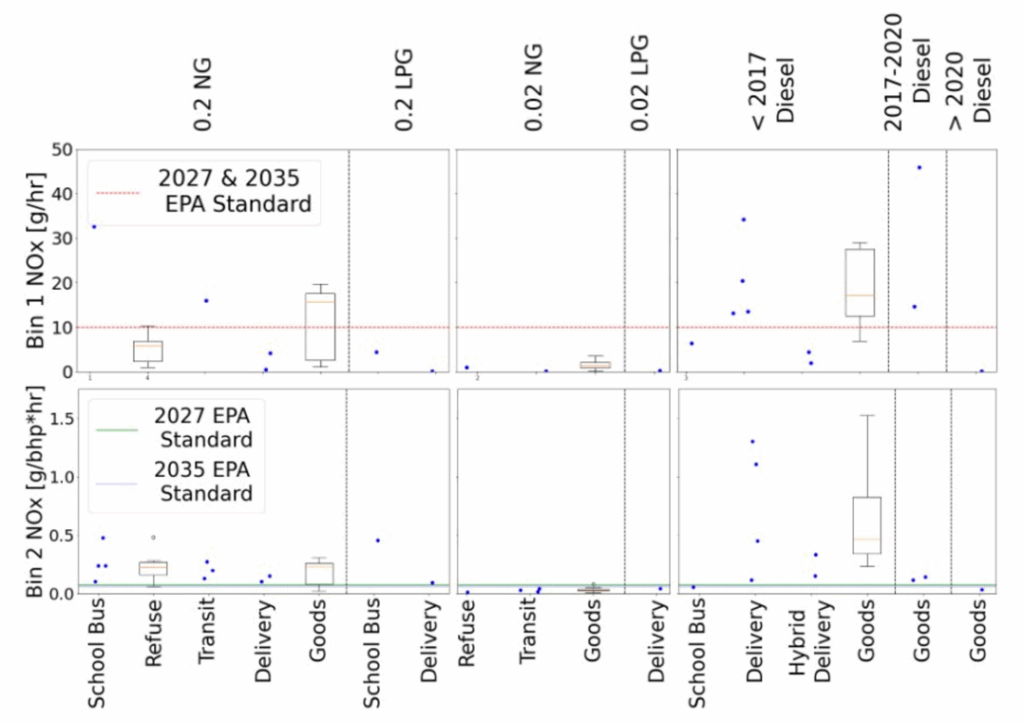
The figure here shows MAW-based NOx emissions for Bin 1 and Bin 2, grouped by fuel and technology. Diesel vehicles showed a clear decline in NOx emissions with newer model years—particularly for goods movement trucks manufactured after 2020, which showed more than 99% and 96% reductions in Bin 1 and Bin 2 emissions, respectively.
Natural gas vehicles exhibited an even more distinct trend, with a step change in emissions performance following the introduction of engines certified to 0.02 g/bhp-h NOx standards starting in 2016. Nearly all such certified vehicles met or exceeded the 2027 and 2035 EPA NOx targets across all vocations.
To evaluate the broader impact of these advancements, UCR used the California Air Resources Board’s EMFAC 2021 model to estimate emissions inventories under different technology adoption scenarios through 2050. By 2050, heavy-duty battery-electric vehicles (BEVs) were expected to comprise about 40% of the fleet, with the remaining 60% made up mostly of internal combustion engine (ICE) HDVs certified to the 2027 standard or newer, with a small residual share of older ICE vehicles.
UCR modified the default EMFAC 2021 emission factors for 2027+ model year trucks to reflect their upcoming lower certification limits. Compared to the baseline case, this change yields a projected 91.9% reduction in NOx emissions between 2025 and 2050—far greater than the 50% reduction estimated using EMFAC’s default emission factors.
UCR also modeled a more conservative scenario in which no BEVs are adopted after 2025, as the timeline for BEV adoption remains fluid, given recent shifts in federal policy and market uncertainties. As shown in the figure here, the “no-BEV” scenario results in only a modest two-percentage-point increase in additional NOx emissions by 2050 relative to the mixed-technology scenario, highlighting the significant role that advanced diesel and natural gas technologies alone can play in emissions reductions..
Understanding the real-world emissions performance of HDVs is crucial for informing policy. As HDV fleet turnover will be a primary driver of emission reductions in this sector, the prioritization of investment in newer combustion engines vehicles could provide additional benefits in the near to medium term—especially in the face of economic or logistical constraints.
Our findings show that both conventional diesel and alternative fuel vehicles certified to the 0.02 g/bhp-h standard can meet future EPA NOx limits even in day-to-day operation. This suggests that even if the transition to zero-emissions HDVs takes longer than expected, modern diesel and natural gas engines can still deliver significant, near-term reductions in NOx emissions—particularly in vulnerable communities affected by freight-related air pollution.
Sign up here to receive such summaries and a monthly newsletter highlighting the latest developments in transport decarbonization
5-Min Monthly
Sign-up to receive newsletter via email
Thank you!
You have successfully joined our subscriber list.
Recent Posts

EPA Demands Manufacturer Data as It Expands Action on DEF System Failures
![]()
A brief summary of recent EPA changes to DEF-related failures.

EPA repeals 2009 GHG endangerment finding
![]()
The US EPA is repealing the 2009 GHG endangerment finding and terminating all vehicular GHG standards.

Efficiency of EVs in US and China
![]()
China has set energy efficiency norms for electric vehicles – how do modern EVs fare?