Regulations

EPA Demands Manufacturer Data as It Expands Action on DEF System Failures

Reference: EPA Press Release

Background

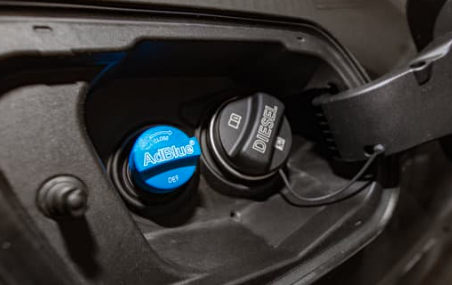
Modern diesel engines use Diesel Exhaust Fluid (DEF) to reduce nitrogen oxide (NOx) emissions through selective catalytic reduction (SCR) technology. DEF decomposes to form ammonia, which reacts with NOx and reduce it to benign N2. On-board diagnostic systems detect the quality and quantity (level) of the DEF in the tank, and if either is compromised – or DEF tank is simply running empty – then current regulations require the engine to operate in a lower power mode (known as inducement), till such time as the issue is fixed.

On- and non-road equipment users -farmers and truckers – have said the derates caused safety concerns, costly delays, and operational disruptions. The U.S. Environmental Protection Agency (EPA) has issued new guidance to ease some of the concerns, and is now also requesting additional information. The EPA has announced additional steps to address DEF system failures that have disrupted operations for farmers, truck drivers, and other diesel equipment operators across the country.

In August 2025, the EPA issued guidance that eased the above mentioned automatic engine power reductions (also known as “derates”). The guidance significantly extended the time before major power reductions take effect.

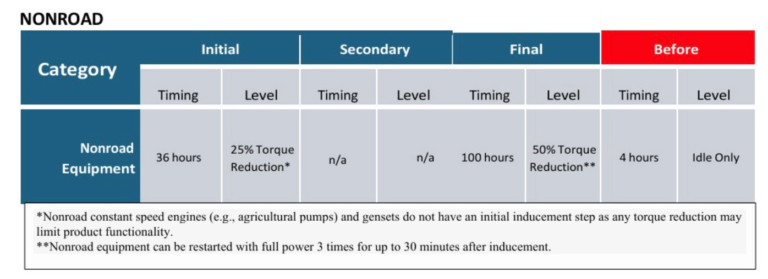
Under current policy, heavy-duty trucks will receive a warning light for up to 650 miles or 10 hours after a fault is detected. Mild derates may follow, but vehicles can operate without speed limits for up to 4,200 miles or roughly two work weeks. Only after about four weeks does speed drop to 25 mph until repairs are made. Nonroad equipment faces no impact for the first 36 hours after a fault (see table).

Example of the changed inducement for non-road equipment

Manufacturer Data

The agency is exploring new rulemaking measures and has formally requested detailed performance data from major diesel engine manufacturers. The EPA has directed manufacturers to implement software updates and is now seeking comprehensive data to better understand the scope and causes of continued failures. It is requiring the top 14 on-road and nonroad diesel manufacturers—representing more than 80% of DEF system products—to submit warranty claims, failure rates, and repair data for Model Years 2016, 2019, and 2023 emission control systems. Manufacturers have 30 days to respond. The information will be used to determine whether failures are linked to specific generations of equipment and guide future regulatory actions.

EPA also clarified that under the Clean Air Act, equipment owners have the right to repair DEF systems on their own farm and nonroad equipment, a move intended to reduce downtime and costs. The agency is concurrently reconsidering aspects of the 2022 Heavy-Duty Engine and Vehicle NOx rule and assessing whether certain derate provisions remain necessary. 

The agency is concurrently reconsidering aspects of the 2022 Heavy-Duty Engine and Vehicle NOx rule and assessing whether certain derate provisions remain necessary. 

Right to Repair

In a related move, EPA also clarified that under the Clean Air Act, equipment owners have the right to repair DEF systems on their own farm and nonroad equipment, a move intended to reduce downtime and costs. Temporary overrides of emission control systems will be allowed when it is for the “purpose of repair” to that equipment to obtain proper functionality.

Sign up here to receive such summaries and a monthly newsletter highlighting the latest developments in transport decarbonization

Recent Posts