Conference Presentation Summary
Direct manufacturing cost of BEV vs ICE
Reference: FEV Consulting Inc., U.S. EPA, 45th International Vienna Motor Symposium
Background
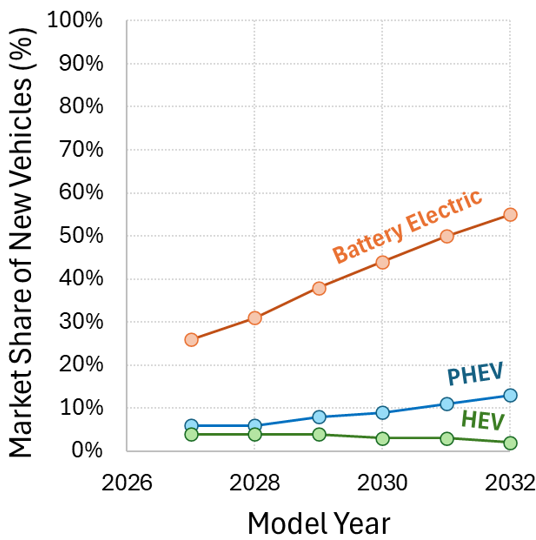
The U.S. EPA has established stringent CO2 tailpipe limits for passenger cars and medium-duty vehicles starting M 2027. We have covered these in an earlier post. The rule will require a fleet averaged 50% reduction in CO2 emissions for light-duty vehicles, over MY 2027 – 2032. The rule, while technology neutral, is clearly expected to promote electrification, and by EPA estimates (shown in the figure) over half of the new vehicle sales will be fully battery electric by 2032.
The EPA, in setting such rules, analyze the cost-effectiveness of new technologies. In a talk delivered at the Vienna Symposium, an example of such an analysis was provided, and we summarize it here. Note that this is limited to direct manufacturing cost, does not cover the markups leading to end customer price and also any reference to the CO2 reduction potential.
Sign up here to receive such summaries and a monthly newsletter highlighting the latest developments in transport decarbonization
5-Min Monthly
Sign-up to receive newsletter via email
Thank you!
You have successfully joined our subscriber list.
Recent Posts

Lifecycle Analysis of U.S. Medium- and Heavy-Duty Vehicle Fuel Pathways
![]()
A recent study published in Environmental Science & Technology evaluates the lifecycle energy use and greenhouse gas (GHG) emissions of medium- and heavy-duty vehicles (MHDVs) in the United States.

EPA Demands Manufacturer Data as It Expands Action on DEF System Failures
![]()
A brief summary of recent EPA changes to DEF-related failures.

EPA repeals 2009 GHG endangerment finding
![]()
The US EPA is repealing the 2009 GHG endangerment finding and terminating all vehicular GHG standards.