Regulations
The Road Ahead for California's Vehicle Emission Standards
Background
Following the recent spate of deregulatory actions by the U.S. EPA, and specifically the revocation of California’s waivers to set its own standards for vehicular emissions, the state could be forgiven for laying low. It’s doing the opposite, planning its next course of action for a dozen years out. What follows is a roundup of the proposed standards by California Air Resources Board (CARB) at a recent “Drive Forward” workshop. This is, as stated, a proposal and it is far from being a final rule. But it provides an insight into the upcoming plans and is also an early opportunity to provide comments.
For further context, see here for background on California’s earlier Clean Cars II proposal.
Overview & Timing of Proposed Targets
The proposed standards apply to light- and medium-duty vehicles. These include
(1) Changes to fleet average CO2 limits
(2) GPF enforcing PM standard and tightening of NOx limit
(2) Lifetime health and durability requirements for ZEV batteries
(3) Provisions to reconsider the utility factor for plug-in hybrids, and new labeling requirements.
(4) A first brake-wear particulate emission limit
California’s proposed standards start in 2031 and phase-in through 2038.
Premium Members – Download below for a detailed summary
This free edition covers the headlines. Premium content includes –
- New CO₂ footprint curves
- NMOG + NOx phase-in charts
- ZEV0 Bin eligibility rules
- “Real-world” test protocols
- Tighter evap. standards for hybrids, plus E15 fuel-compatibility testing
- Fleet Utility Factor changes for plug-in hybrids
- And more
Key Takeaways
Some of the key aspects of the proposal include:
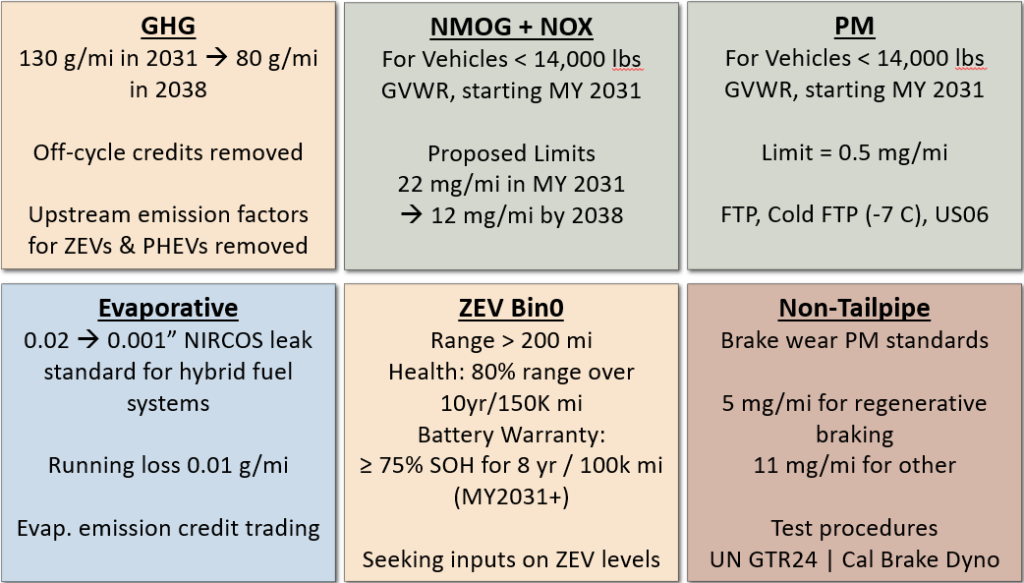
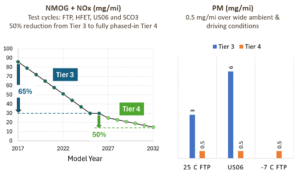
- Tailpipe particulate mass (PM) limit of 0.5 mg/mi, across all test conditions including at -7 C. This is a per vehicle, not a fleet-averaged standard, and enforced particulate filters.
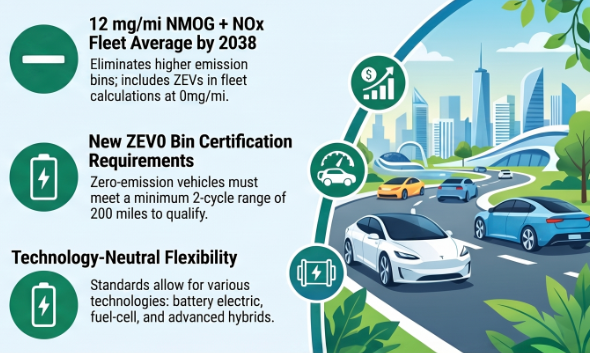
- For light-duty vehicles, fleet averaged NMOG + NOx reduced to 12 mg/mi (compared to 30 mg/mi today) – including ZEVs, which are treated as 0 mg/mi. For medium-duty vehicles, the limit tightens from 170 mg/mi in 2031 to 100 mg/mi in 2033. Also included are changes to emission bins (addition of Bin 0) and changes to test procedures.
- A brake-wear particulate standard of 5 mg/mile for lighter vehicles from model year 2031, tested under the UN GTR24 procedure
- ZEVs required to maintain 80% of their certified range for 10 years or 150,000 miles, paired with a consumer “battery label” that reports highway range at 70 mph, range in cold (20°F) and hot (95°F) conditions, and charging recovery rates
- Battery warranty requirement for > 75% state of health for 8 years / 100,000 miles
- While this proposal does not specify ZEV sales targets, these are under consideration and comments were sought.
- The proposal also does not specify a change in the utility factor for plug-ins – but requests comments and also contemplates a change specific to extended range EVs.
- And more .. as always, the details matter.
What Comes Next?
The proposal is preliminary, and CARB has invited public and industry comment by July 17, 2026. MobilityNotes will track the rulemaking as draft regulatory text is released.
MOBILITYNOTES MEMBERS: Click below to download the premium article, which includes a detailed summary of this important proposal.
Sign up here to receive such summaries and a monthly newsletter highlighting the latest developments in transport decarbonization
5-Min Monthly
Sign-up to receive newsletter via email
Thank you!
You have successfully joined our subscriber list.
Recent Posts

The Road Ahead for California’s Vehicle Emission Standards
![]()
An overview of CARBs proposed light- and medium duty “Drive Forward” proposal for MY 2031+ vehicles
EPA Proposes Two-Year Delay to Tier 4 Vehicle Emission Standards
![]()
The U.S. EPA has proposed a two-year delay for the introduction of the previously announced Tier 4 emission standards for light- and medium-duty vehicles.