Regulations
EPA Proposes Two-Year Delay to Tier 4 Vehicle Emission Standards
Source: EPA
Background
On May 14, 2026, the U.S. Environmental Protection Agency (EPA) published a Notice of Proposed Rulemaking (NPRM) to delay the implementation of Tier 4 criteria pollutant emission standards for light-duty and medium-duty vehicles. The Tier 4 standards, finalized in April 2024 as part of the Light- and Medium-Duty Vehicle (LMDV) Multipollutant Rule, were originally scheduled to begin phasing in with model year (MY) 2027.
Under the proposal, existing Tier 3 standards would be extended through MYs 2027 and 2028, with the Tier 4 phase-in resuming in MY 2029. This is Part 1 of a two-part rulemaking; a future Part 2 will comprehensively reconsider the Tier 4 program itself.
What’s at stake?
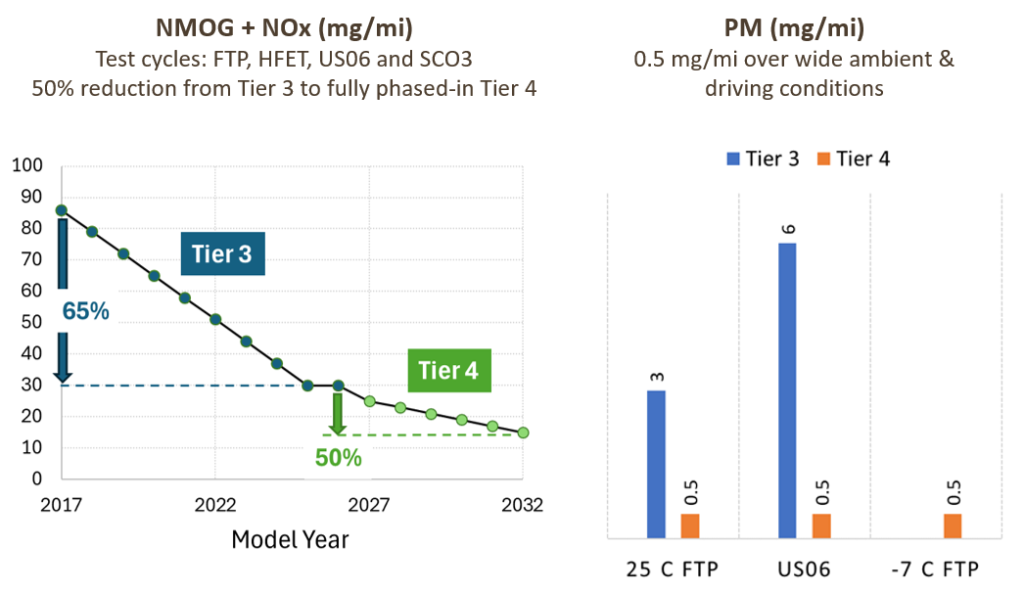
The proposed Tier 4 standards require a 50% reduction in combined NMOG + NOx emissions, and the introduction of a filter-enforcing 0.5 mg/mi particle mass limit over a broad range of driving and ambient conditions. These were slated to go into effect starting MY 2027, requiring introduction of advanced emission control systems – but are now being pushed out by two years, with a possible review of the stringency to come.
Why the delay ?
The EPA cites three major changed circumstances since April 2024 that undermine the feasibility assumptions behind the Tier 4 standards:
- BEV market share projections have collapsed: from 26% and 31% for MYs 2027/2028 (original rule) to 8% and 12% respectively in current projections.
- California ACC II waiver disapproval: The Congressional Review Act (CRA) eliminated the largest state-level EV mandate in June 2025, affecting 13 states.
- EV incentives removed: The One Big Beautiful Bill Act (July 2025) ended the Section 30D BEV tax credit and other purchase incentives.
The EPA reasons that without high BEV penetration, manufacturers now face significantly greater challenges meeting the previously proposed Tier 4 standards through ICE vehicle improvements alone. A key example is meeting the declining NMOG + NOx fleet averages without the associated CO2 reductions in place.
Near-Term Emissions Impact
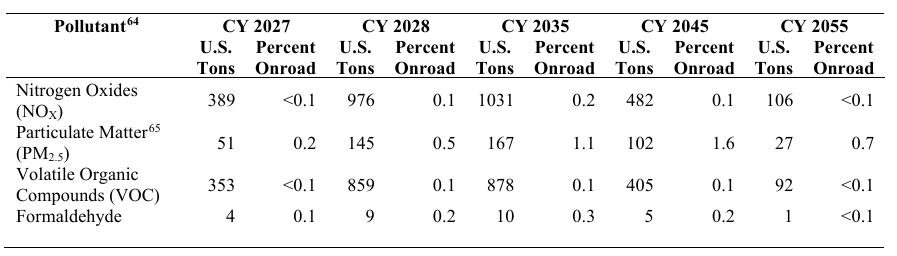
EPA projects modest increases in national onroad emissions from the two-year delay. By calendar year 2028, the delay would result in approximately 976 additional tons of NOx, 145 tons of PM2.5, and 859 tons of VOC nationally. The PM2.5 impact is the most persistent, reaching 1.6% of total national onroad PM2.5 by 2045.
What Comes Next?
Public hearings are scheduled for June 3–4, 2026, with written comments due by July 6, 2026. Finalization of Part 1 is expected in late 2026. The Part 2 rulemaking, which could fundamentally revise PM, NMOG+NOx, CO, and formaldehyde standards as well as test procedures, has no announced timeline
MOBILITYNOTES MEMBERS: Click below to download the premium article, which includes a detailed analysis of the rationale for the proposed delay, the implications for various aspects of the original Tier 4 rule, and key EPA comment solicitaions.
Sign up here to receive such summaries and a monthly newsletter highlighting the latest developments in transport decarbonization
5-Min Monthly
Sign-up to receive newsletter via email
Thank you!
You have successfully joined our subscriber list.
Recent Posts

EPA Proposes Two-Year Delay to Tier 4 Vehicle Emission Standards
![]()
The U.S. EPA has proposed a two-year delay for the introduction of the previously announced Tier 4 emission standards for light- and medium-duty vehicles.

ACT Expo 2026 – Propane Technologies Gain Momentum
![]()
Propane for buses, medium-duty and Class 7 trucks – and electrification? A range of exciting advances shown at the 2026 ACT Expo.

Delhi Proposes Mandatory EV-Only Registrations for Two- and Three-Wheelers
![]()
A summary of Delhi’s draft EV Policy, which is amongst the most aggressive electrification mandates announced by any major city globally.