Tech Brief
Lifecycle Analysis of U.S. Medium- and Heavy-Duty Vehicle Fuel Pathways
Reference: Environmental Science and Technology
Introduction
Freight transportation is a major contributor to greenhouse gas emissions in the United States. Medium- and heavy-duty vehicles play a critical role in goods movement but rely heavily on fossil fuels, particularly diesel. As policymakers and industry leaders seek pathways to reduce emissions, it is essential to understand the full lifecycle impacts of emerging vehicle technologies and fuel systems. A recent study published in Environmental Science & Technology evaluates the lifecycle energy use and greenhouse gas (GHG) emissions of medium- and heavy-duty vehicles (MHDVs) in the United States.
Methodology
The study uses the GREET (Greenhouse Gases, Regulated Emissions, and Energy Use in Technologies) model to perform a cradle-to-grave lifecycle analysis. The assessment includes:
- Vehicle manufacturing
- Fuel production and distribution
- Vehicle operation (use phase)
- End-of-life disposal and recycling
Multiple powertrain and fuel pathways were evaluated, including:
- Conventional diesel internal combustion engines
- Hybrid electric vehicles (HEVs)
- Battery electric vehicles (BEVs)
- Hydrogen fuel cell electric vehicles (FCEVs)
Both present-day (2021) and projected future (2035) technologies were analyzed.
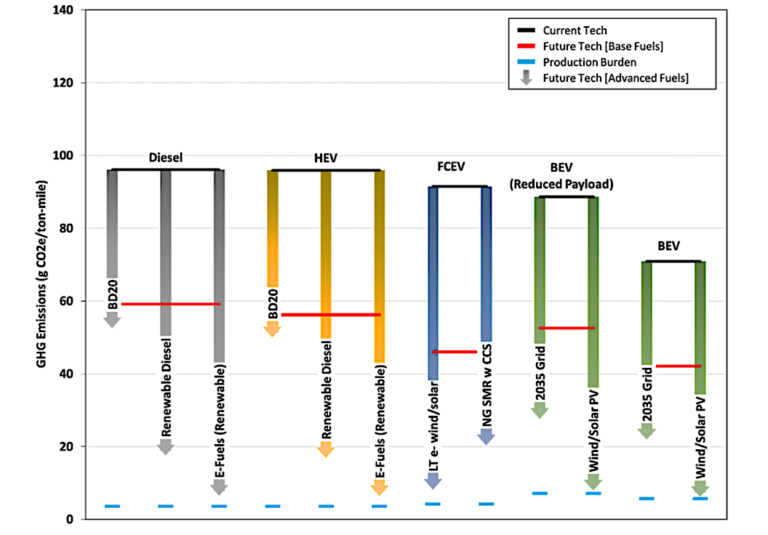
Cradle-to-grave GHG emissions per ton-mile associated with the Long-haul truck by powertrain for the Current and High Future technology level.
Some Findings
A lot of important results in this study and we encourage the reader to refer to the original publication. But here are a few high-level findings:
There is a wide spread on the advantage offered by alternative powertrains based on the fuel carbon intensity. Battery electric vehicles (BEVs) offer the greatest greenhouse gas (GHG) reductions, lowering emissions by about 10–60% per ton-mile compared to diesel trucks, while fuel cell electric vehicles (FCEVs) achieve reductions of roughly 5–50%, depending on hydrogen production and efficiency. Emissions benefits depend heavily on the carbon intensity of electricity and hydrogen, and in weight-limited applications, heavy batteries can reduce BEV payload capacity.
There is a lot of room for improvements for conventional diesels – efficiency improvements are anticipated to reduce GHG emissions to below what BEVs offer today. Of course combined with renewable fuels holds further potential for deeper decarbonization. By 2035, improvements in vehicle efficiency and cleaner energy sources could enable lifecycle GHG reductions of over 70% relative to diesel, highlighting the importance of decarbonized fuel pathways. Hybridization, as shown in the figure for long-haul application, does not offer much, but the situation looks very different for a Class 6 Box truck where hybrids help.
Key Takeaway
With the increasing market share of alternative fuels and powertrains, the transportation industry is calling for a move away from tailpipe-only standards and for an accounting of GHG emissions from a well-to-wheel or even a cradle-to-grave perspective. This is being brought into sharp focus with recent changes in GHG regulations and electrification mandates, underscoring the importance of system-wide evaluation in transportation decarbonization efforts. While alternative fuels and zero-tailpipe powertrains have the potential of significant significant emissions reductions compared to diesel vehicles, the extent depends on the carbon intensity of the fuel or electricity used. Achieving deep emissions cuts in the freight sector will require coordinated progress in vehicle technology, energy infrastructure, and fuel production pathways. This paper points to several of these pathways which should be pursued – and that there is no single solution which is necessarily the best for all applications.
Sign up here to receive such summaries and a monthly newsletter highlighting the latest developments in transport decarbonization
5-Min Monthly
Sign-up to receive newsletter via email
Thank you!
You have successfully joined our subscriber list.
Recent Posts

Lifecycle Analysis of U.S. Medium- and Heavy-Duty Vehicle Fuel Pathways
![]()
A recent study published in Environmental Science & Technology evaluates the lifecycle energy use and greenhouse gas (GHG) emissions of medium- and heavy-duty vehicles (MHDVs) in the United States.

EPA Demands Manufacturer Data as It Expands Action on DEF System Failures
![]()
A brief summary of recent EPA changes to DEF-related failures.

EPA repeals 2009 GHG endangerment finding
![]()
The US EPA is repealing the 2009 GHG endangerment finding and terminating all vehicular GHG standards.