
Electric Vehicles

Efficiency of EVs in US and China

China has set an efficiency limit of 15.1 kWh/100km (0.243 kWh/mile) for electric passenger cars. This rule (GB 36980.1—2025) went into effect January 1st, 2026 and is seen as a major step in setting energy efficiency standards for electric vehicles, leading to improved batteries and driving range. 


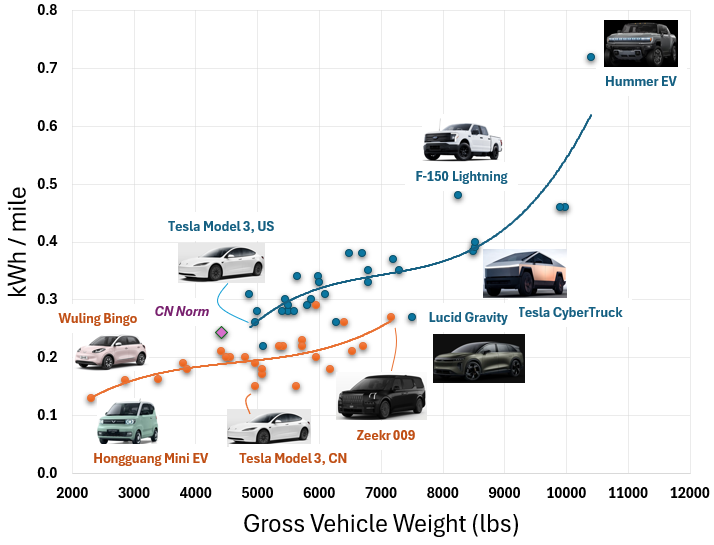
We have compiled the energy efficiency of a few major battery electric vehicles sold in China and the US, to put this standard in context. The figure below is a summary of this data, along with the new standard, marked as “CN Norm”.

Some Observations

There’s a lot to unpack in the figure above, here are some observations:

  • Clearly, China has several BEVs in the lighter segment (< 4,500 lbs) compared to the US, and most vehicles – even those with gross vehicle weight (GVW) up to 7,000 lbs seem to be well poised to meet the new standard.
  • The efficiencies in US and China are not comparable, however. Take the Tesla 3 as an example – it apparently requires a whopping 42% lower energy in China per mile compared to the US. This makes sense only when it understood that the test procedures in the two regions are different, and that the range in China is measured on the CLTC, a test cycle that is not the same as the real-world driving range measurement in the US.
  • Nevertheless, the chart shows the possibilities for improving energy efficiency: several cases are seen, even in the same region where vehicles of similar weight have widely varying energy consumption. See Lucid Gravity as an example, which has an energy efficiency similar to the Tesla Model 3, despite being~ 2,500 lbs heavier !
  • The mini-car segment in China is unique to the country and unlikely to be popular in the US anytime soon, but show that lighter vehicles can be super energy efficient.
  • Note that we do not comment on the battery chemistry here but it is understood that this is a combination of Li-NMC and Li-LFP chemistries (especially the latter popular in China), with implications for cost.
 
We had compiled a similar summary, only for the US, two years ago. A quick look at that picture shows that unfortunately, the efficiencies have not changed much in these two years. Perhaps this makes the case for the energy efficiency norms as set in China, are required for all regions. 

MOBILITYNOTES MEMBERS: Click below to download the revised fuel economy curves with the underlying calculations.

Membership Required

You must be a member to access this content.

View Membership Levels

Already a member? Log in here

Sign up here to receive such summaries and a monthly newsletter highlighting the latest developments in transport decarbonization

Recent Posts