
Regulations
Europe proposes to drop 100% tailpipe CO2 emissions target
Based on proposal by EU Commission, published on December 16th, 2025
Batteries and internal combustion engines can co-exist beyond 2035, if the European Commission’s proposal is to be accepted. In a significant change from the previous target of 100% reduction in tailpipe CO2 emissions from passenger cars starting 2035, the Commission has proposed a 90% reduction instead, compared to a 2021 baseline. This is being hailed as a major breakthrough by the automotive industry, and a sky-is-falling-level setback by enviros. Possibly both are exaggerating, for the change is not as significant as the headline makes it seem. Here are some supporting details.
What’s Changing ?
CO2 fleet-wide emission targets vs. 2021 baseline revised:
(1) 2030 target for Vans : Reduced from 50% to 40%
(2) 2035 target for Cars & Vans : Reduced from 100% to 90%
– Remaining emissions to be compensated by use of made-in-EU low-C steel or sustainable renewable fuel credits
– Fuel credits to be based on volume and GHG carbon intensity
– Fuels shall be renewable fuels of non-biological origin (RFNBOs), biofuels and biogas produced by specified feedstock (Directive (EU) 2018/2001)
– Fuel credits shall not reduce CO2 emissions by > 3% of fleet-wide target, and not by > 1% for biofuels & biogas
– Low C steel credits not reduce CO2 emissions by > 7% of fleet-wide target
- All ZEV N vehicles with mass without battery < 2840 kg are counted as LCVs and included in accounting for CO2 compliance
- CO2 super credits for small electric cars made in EU: Each vehicle counted as 1.3 vehicles
- Flexibility : Avg. CO2 emissions to be met over 2030 – 2032
- Fines of €95 / vehicle / CO2 exceedance for
- Additional labeling requirements for EVs
Putting it together –
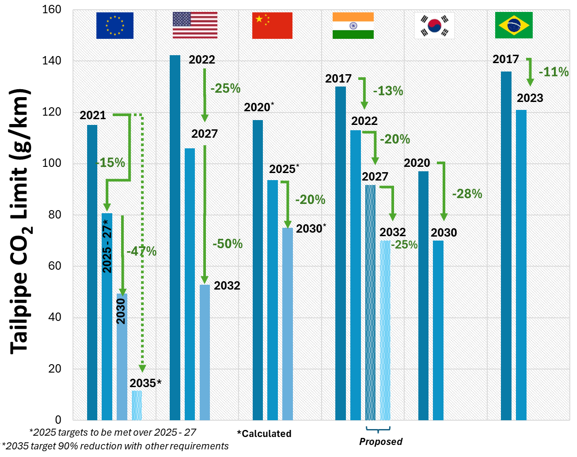
Global CO2 standards for major markets are shown here. This includes the standards for US MY 2027 – 2032, which are very likely to be on the chopping block in early 2026. The standards in India are also under scrutiny, especially due to some provisions which favor small vehicles. The main change for now, is the revision of the European 2035 target, which previously hugged the x-axis and is now at a 90% reduction vs. the 2021 baseline.
Early Analysis
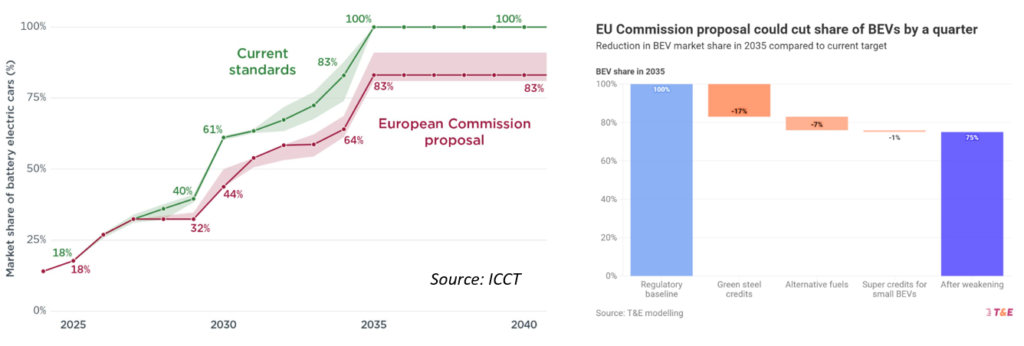
Various groups have started estimating the impact of the changed target on battery electric share and CO2 emissions. Two examples, ICCT and Transport&Environment, show that the BEV share could reduce 17 – 25 percentage points in 2035 with a similar reduction even in the near-term at 2030.
Perhaps an overlooked question is what impact this will have on the hydrogen market, given its possible increased demand for green steel.
MOBILITYNOTES MEMBERS: Click below to download the CO2 Limits plot with underlying data.
Sign up here to receive such summaries and a monthly newsletter highlighting the latest developments in transport decarbonization
5-Min Monthly
Sign-up to receive newsletter via email
Thank you!
You have successfully joined our subscriber list.
Recent Posts

EPA Demands Manufacturer Data as It Expands Action on DEF System Failures
![]()
A brief summary of recent EPA changes to DEF-related failures.

EPA repeals 2009 GHG endangerment finding
![]()
The US EPA is repealing the 2009 GHG endangerment finding and terminating all vehicular GHG standards.

Efficiency of EVs in US and China
![]()
China has set energy efficiency norms for electric vehicles – how do modern EVs fare?